|
Physics and Acoustics of Baseball & Softball Bats
Daniel A. Russell, Ph.D. Graduate Program in Acoustics The Pennsylvania State University The contents of this page are ©2003-2012 Daniel A. Russell |
|
In 2004 I came across annual statistics published by the NCAA for Division I college baseball starting starting in 1970. The raw data includes yearly results for batting averages, home runs per game, runs scored per game, strikeouts per 9 innings, pitcher earned-run-averages, stolen bases, and fielding percentages.[1] In this article I will display the statistical data graphically and discuss the performance trends aluminum and composite bats as well as identifying the effects of bat performance standards. But, before I start discussing the NCAA data trends below, I want to highlight several important dates regarding the performance of baseball bats:
Home Runs and Runs Scored per Game
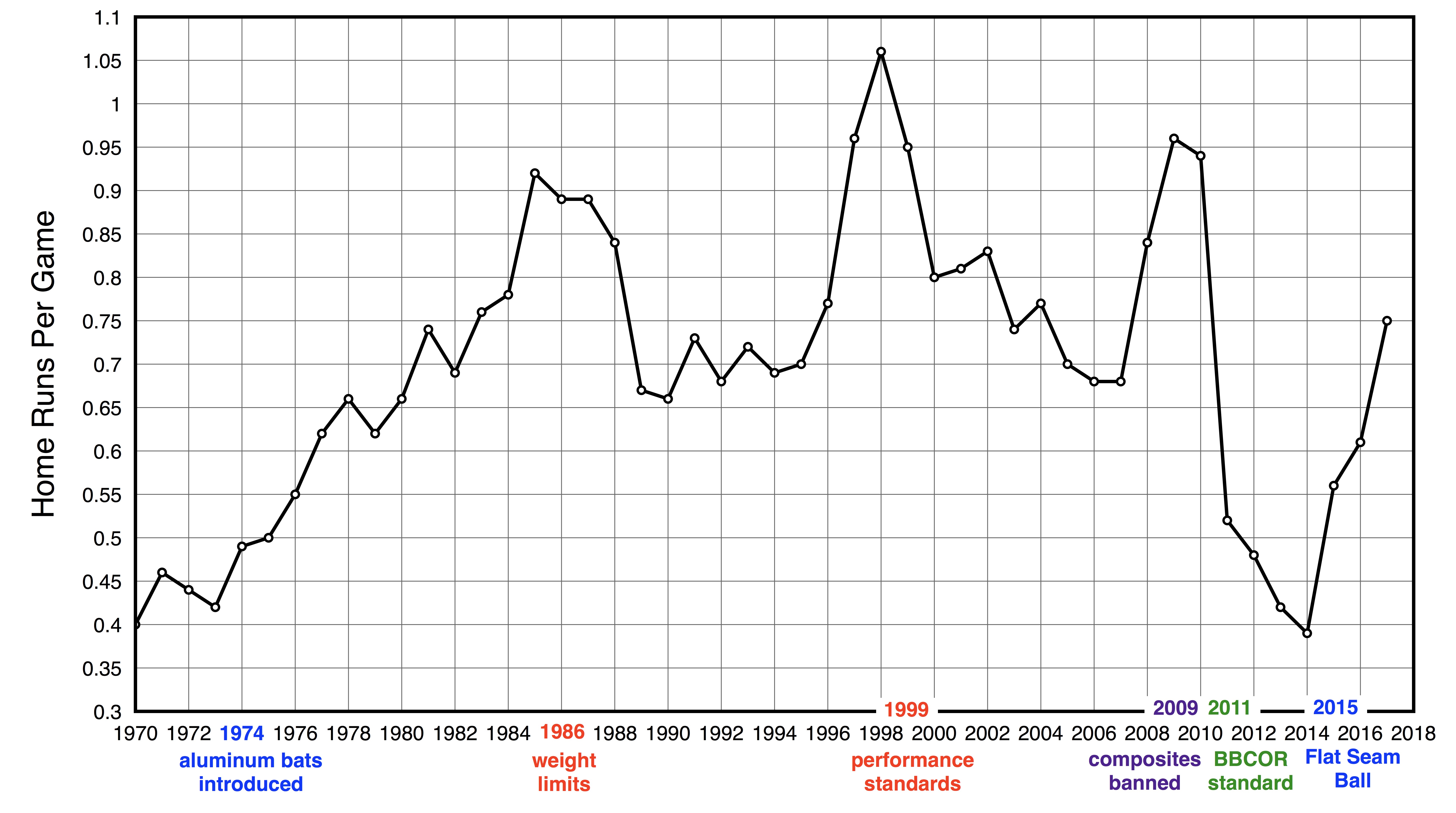
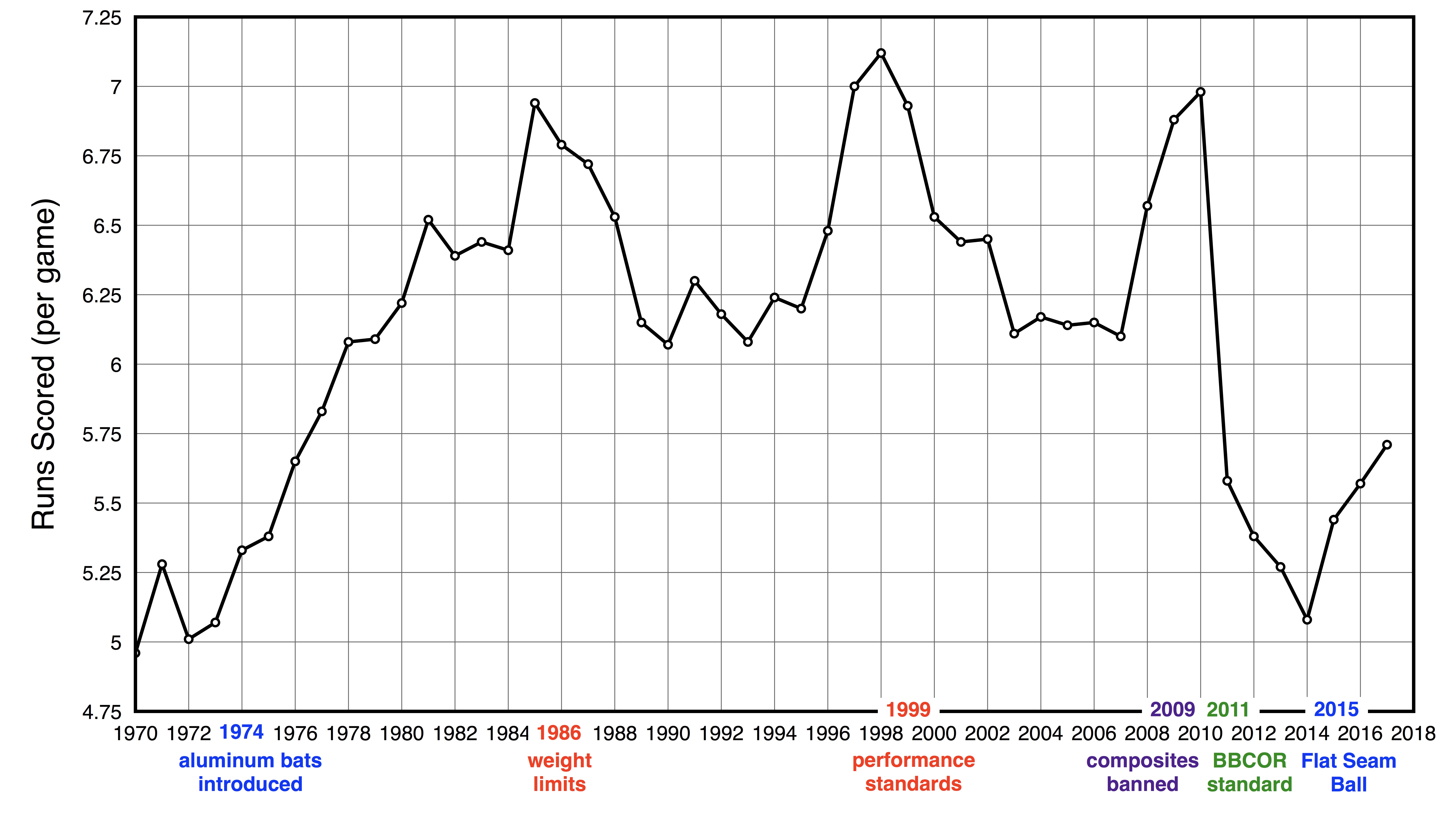
The number of home runs per game and runs scored per game are perhaps the two trends that reveal the most information about bat performance in the field. When players are swinging hotter bats, they will more frequently hit the ball out of the park for a home run and teams will tend to score more runs during a game. Furthermore, the proliferation of home runs and runs scored was the primary reason that performance standards were first implemented in 1999 and significantly modified in 2011.
The two plots at right shows the number of home runs per game and the total number of runs scored per game for NCAA Division I college baseball from 1970 through 2012. Both data sets indicate that immediately after aluminum bats were introduced in 1974, a greater percentage of hit balls began going over the fence and more runs were being scored each game. There is a steady increase after aluminum bats were introduced until 1986 when weight limits were imposed. I don't know exactly what happened in the early 1980's to produce the surge in home runs, but 1985 was the year the very popular Easton Black Magic baseball bat was introduced.[6] The drop in home runs and runs scored after 1985 may be due to the fact that the NCAA introduced the "minus 5" rule after that year. This rule stated that the numerical difference between the bat weight (in ounces) and the weight (in inches) could not be more than 5 units. A 34-inch bat manufactured in 1986 could weigh no less than 29 ounces. This change would have had an effect on bat swing speeds and might partly explain the immediate drop in batting averages starting in 1986. But, bat performance didn't stay down for long. Starting in 1996 batting averages began increasing at a dramatic rate, reaching an record high during the 1998 season. The NCAA Baseball Rules Committee had convened a "bat summit" in 1994 and bat manufacturers agreed use the Brandt BPF test (designed to measure the performance of softball bats) to measure baseball bat performance with a "gentleman's agreement" not to produce bats hotter than those used in 1994. However, as the data clearly shows, bat performance increased sharply during 1996-1998, even though manufacturers claimed their bats were passing the Brandt test. The 1998 College World Series saw a record number of NCAA records broken,* and the number of home run and runs scored per game reached an all-time high. Alarmed by this drastic increase in performance, the NCAA implemented a bat performance standard for the 1999 season. Effective in August 1999, the NCAA adopted BESR performance standard, along with the "minus-3" rule for bat length and weight, introduced a lower limit on a bat's moment-of-inertia, and a reduction in the maximum allowed barrel diameter. Once bat performance was being controlled through laboratory testing and certification processes, bat performance quickly dropped, and from 2003-2007, bat performance returned to levels seen between 1978-1982 and 1989-1995.
At the same time the NCAA was deliberating over what to do with composite bats, they were also considering a significant change in their bat performance standard. In October 2008, the NCAA announced plans to abandon the BESR performance standard standard for a new BBCOR standard, effective January 1, 2011.[4] This change was implemented after extensive testing confirmed the scientific prediction that non-wood bats which passed the BESR + MOI performance standard could indeed hit balls up to 5-6 mph faster than a high performance wood bat. The new BBCOR requires that all bats must produce a bat-ball-coefficient-of-restitution that equals 0.50 or less - which is the maximum value for a wood bat. From the data I have seen, this means that about 70% of the BESR-approved bats available for play during the 2009-2010 season are no longer legal for play today. The effects of the BBCOR=0.50 standard are very obvious. As I had expected, the NCAA adoption of the BBCOR=0.50 bat standard in 2011 has caused the number of home runs and runs scored per game to drop almost to pre-aluminum values (the lowest number of home runs per game since 1974). This is very significant. Using the new BBCOR bats, players are not hitting home runs with anywhere near the frequency that they had during the last 30 years. * During the 1998 College World Series between the University of Southern California Trojans and Arizona State University Sun Devils (USC won 21-14) at least 35 out of 111 CWS records were broken and 17 more were tied.[7,8] Both teams used Louisville Slugger aluminum bats. Records broken during the championship game included runs scored (35), home runs (9), RBI's by one player (7). During the championship series USC also set records for team batting average (.378), runs scored (62), hits (88), and total bases (152). |
Batting Averages
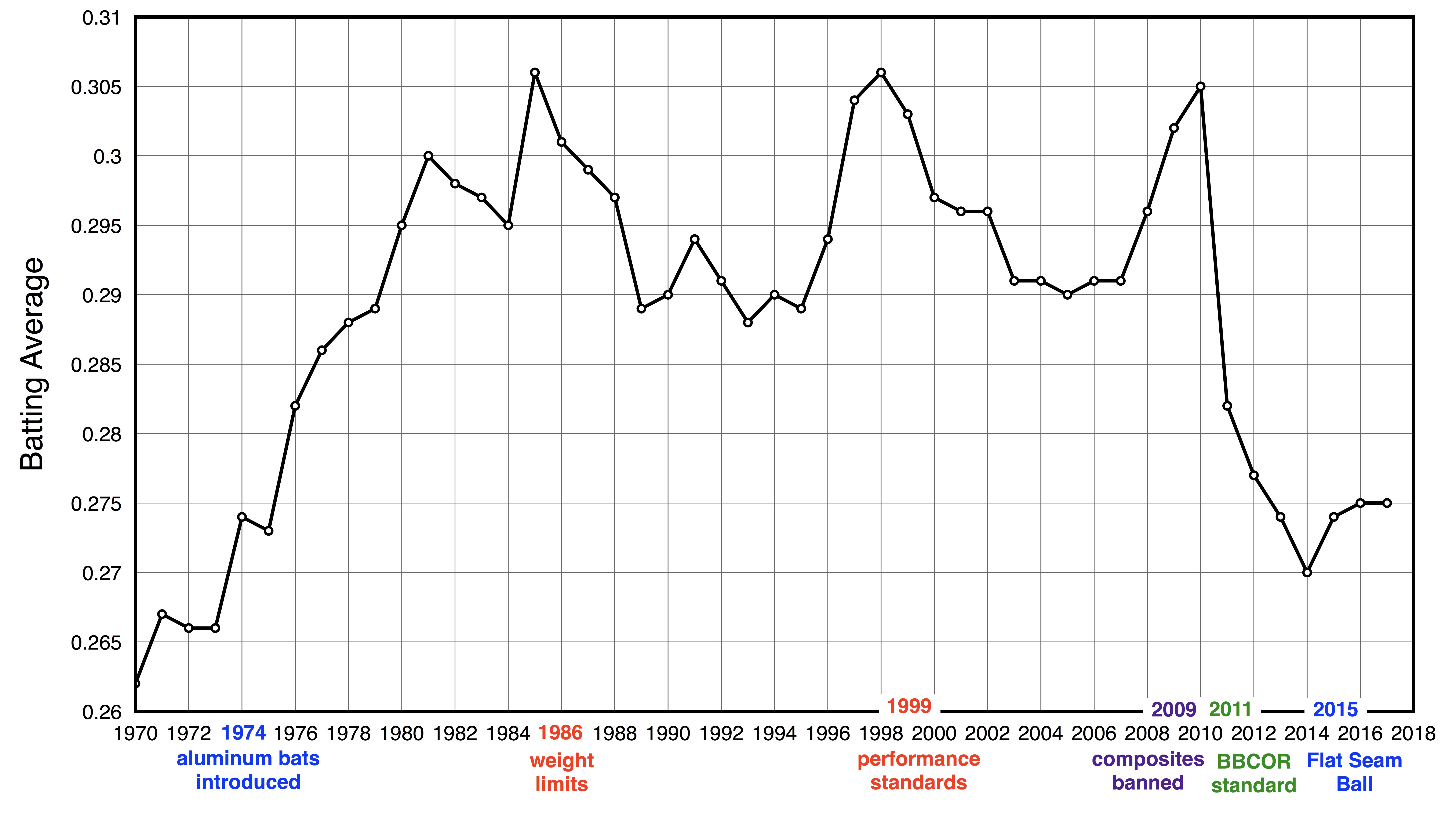
The plot at right shows the mean batting average for all NCAA Division I college baseball players as a function of year from 1970 through the middle of the 2012 season.The data for batting averages pretty much follows the same trends as the home runs and runs scored per game data. However, batting average tells a slightly different story as it indicates how often a player made solid contact with the ball resulting in at least a single or more and relates more to bat control than power.
It is interesting to note that from 1970 through 1981 there appears to be an almost steady increase in batting average. However, it would be incorrect to extrapolate before 1970 to assume that batting averages have always been increasing from .000 at some point in the past. Instead it is more likely that the mean batting averages in the wood era prior to 1970 fluctuated around a value near 0.265 or so, though even this is speculation. The mean batting average spiked to 0.300 in 1981 and spiked even higher to 0.306 in 1985 before dropping and leveling our around 0.290 for most of the early 1990's. An increase from 0.265 to 0.290 (or higher) is quite significant, and suggests that players using aluminum bats make solid contact with the ball more often than former players did with wood bats. However, as we will see below, during the same time period that batting averages were quickly increasing, pitchers had increasing difficulty striking batters out, with the number of strikeouts per 9-innings reaching an all-time low in 1981. Pitchers were still struggling in the early 1990's. So, it is difficult to conclude whether the higher batting averages are due primarily to aluminum bats, or poor pitching, or a combination of both. Two things are true. First is the fact that aluminum bats typically have lower moments-of-inertia than metal bat and therefore may be swung more quickly. A batter who can swing the bat faster has a much higher chance of making contact with the ball since he can wait slightly longer to watch the ball before committing to a swing. Secondly, since metal bats don't break many pitches that might have resulted in a broken bat dribbler for an out with a wood bat now result in base-hit singles from an aluminum bat. The drop in batting average after 1985 is very likely due to the increase in bat weight resulting from the "minus 5" rule introduced by the NCAA that year. This rule stated that the numerical difference between the bat weight (in ounces) and the weight (in inches) could not be more than 5 units. A 34-inch bat manufactured in 1986 could weigh no less than 29 ounces. This change would have had an effect on bat swing speeds and might partly explain the immediate drop in batting averages starting in 1986. The effects of the BBCOR=0.5 standard as of 2011 are very obvious. By the end of the 2011 season, batting averages dropped almost to pre-aluminum values. This is very significant. Using the new BBCOR bats, players are not putting the ball into play nearly as frequently as they did in previous years. Before moving on to look at other data I should point out one other statistic I found which demonstrates that regardless of the bat, good hitters will find ways to make contact with the ball. In 1957 during the wood-only era the best college team batting average was 0.473. In 1994, when aluminum bats ruled the game, the best team college batting average was 0.474.[5] So, while one could well argue that aluminum bats have helped the average player to make solid contact with the ball more often, the best players in the game are able to hit about the same with wood or aluminum, at least when it comes to batting averages. |
Strike Outs per 9 Innings
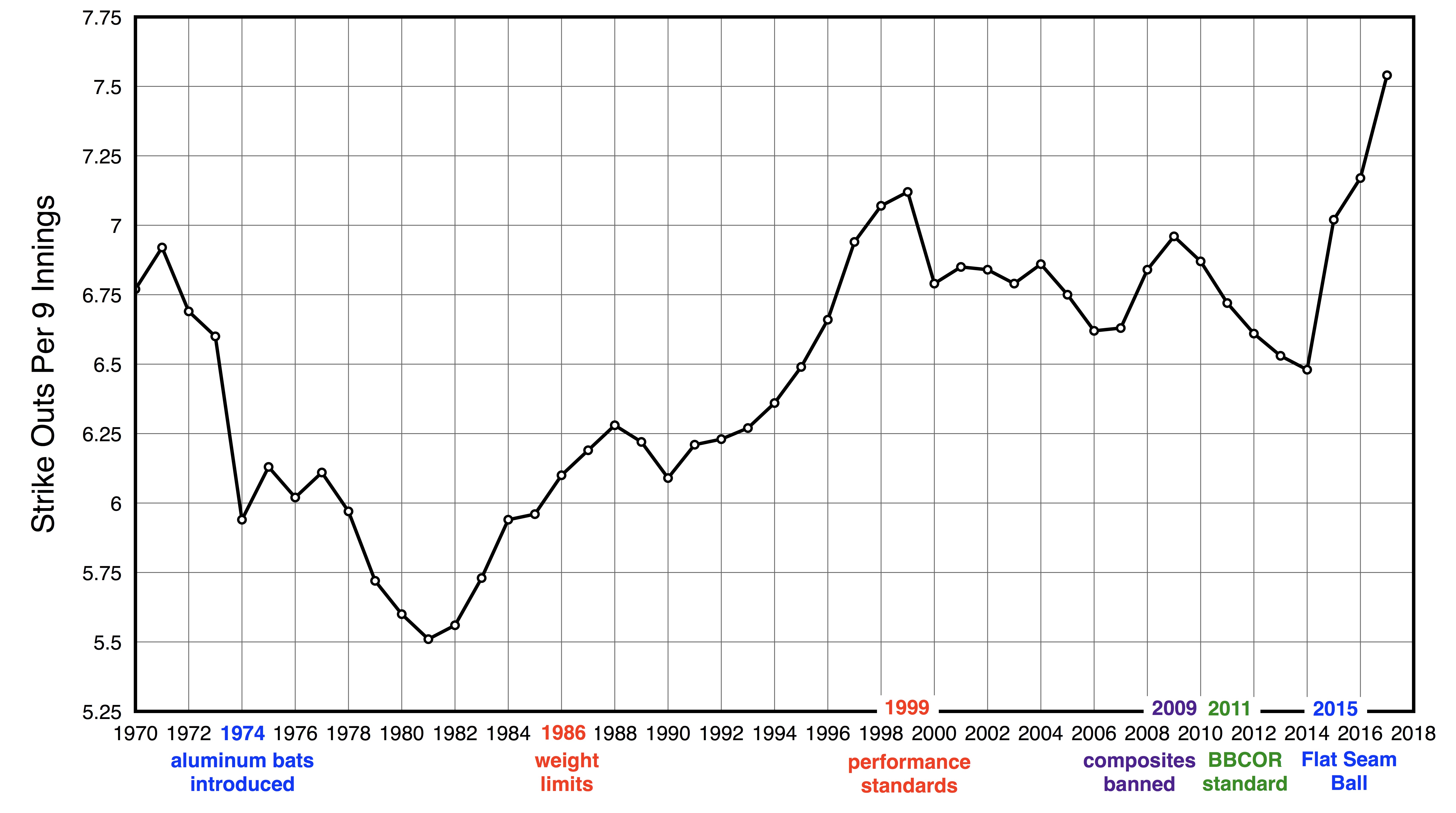
An interesting data set is the number of strike outs per 9 innings for NCAA Division 1 college pitchers. During the same years that batting averages, home runs, and runs scored were increasing, pitchers were having a terrible time getting hitters to strike out. This may not be directly related to the introduction of aluminum bats, and bad pitching may also be part of the reason why batting averages and home runs increased in the years after aluminum bats were introduced to college baseball. Notice, for example, that the number of strike-outs per nine innings dropped by a full strike-out in the three years before aluminum bats were introduced.
However, it is true that aluminum bats have had an impact not only on hitting, but also on pitching. One of the biggest impacts of aluminum bats on the pitching game is that they took away the effectiveness of inside pitches.[9] When batters were swinging wood bats, a pitcher could throw an inside pitch in attempt to jam the hitter. If the batter made contact with the ball it would likely be on the handle or the taper region of the bat. Balls hit in the handle or taper region of a wood bat don't go very far, and often result in a broken bat. As a result, pitchers could get a lot of players out by throwing inside pitches to batters swinging wood bats. However, aluminum bats don't break for hits on the handle. In fact, many hitters can still put the ball in play beyond the infield when the ball is hit from the handle or taper region of a metal bat. Some of the effects of aluminum bats on pitching can even be seen in the majors. Older pitchers like Ryan Nolan or Roger Clemens who grew up in the wood only era learned to effectively use inside pitches to intimidate batters. They liked to throw inside and often intentionally brushed back (and sometimes hit) batters who crowd the plate. Many younger batters are used to being able to crowd the plate and get upset when a pitcher throws an inside pitch. And many younger pitchers aren't nearly as likely to throw inside pitches because they have learned through years of experience that inside pitches can be hit (by players using metal bats). An interesting feature of the strike out data is that the number of strike outs began to increase in the late 1990's and reached an all-time peak in 1999, right around the same time that batting averages and home runs reached their peaks. This would suggest that most batters were either hitting long balls for extra bases and home runs or striking out. It would be interesting to see the break down for base hits and doubles compared to home runs and strike outs for the same time period. I would expect to see a drop in base hits during that time period. As a final note the data shows that during the last few years that the number of strike outs per 9 innings is right about the same as it was back in the wood-only era prior to 1974. College pitching seems to be catching up to metal bat technology. |
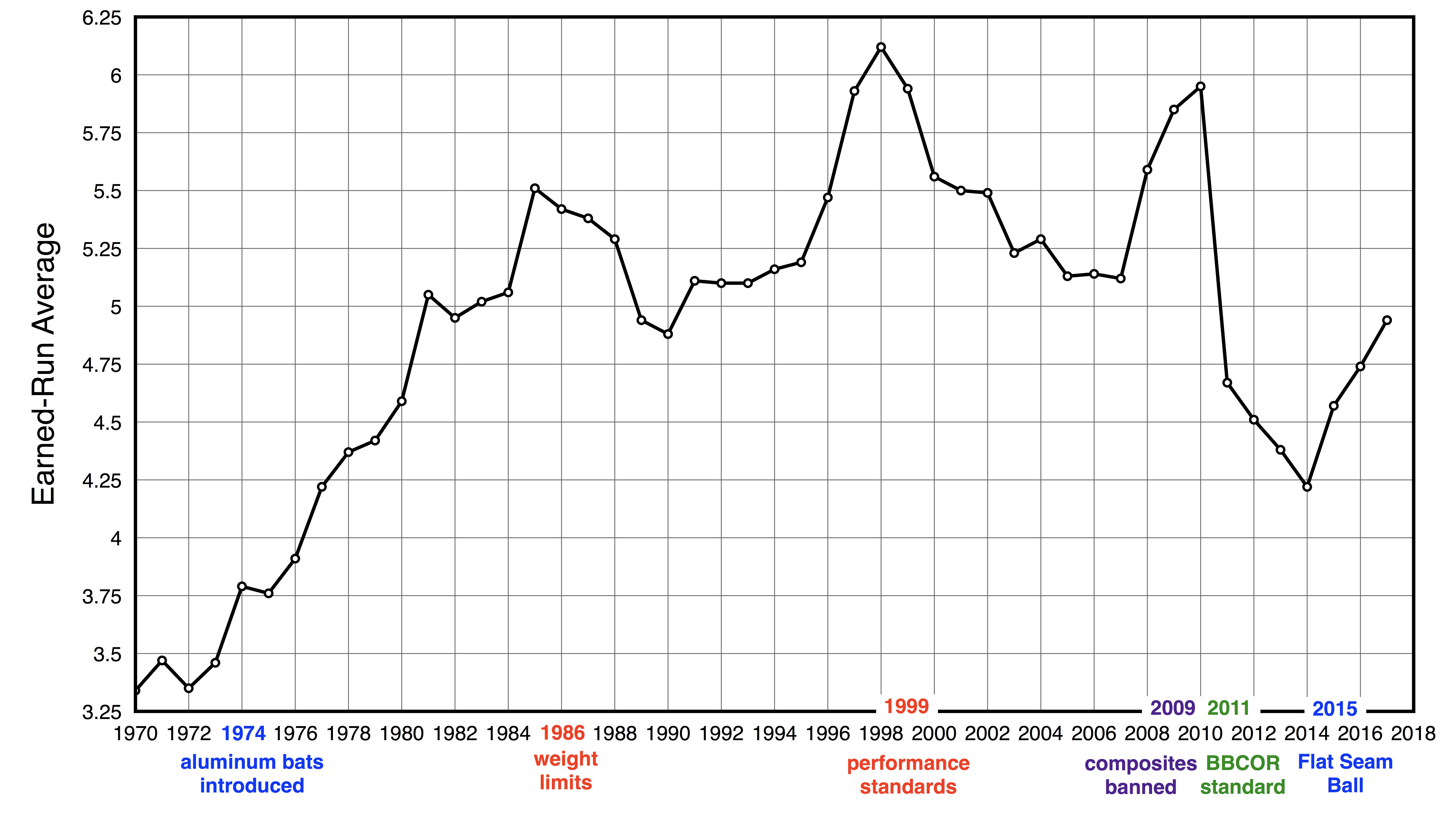
Earned-Run Averages
The historical trend of the earned-run averages for college pitchers pretty much follow the same trends as home runs per game and batting averages. However, the earned-run average data is quite informative, because a comparison between ERA data and the number of strike-outs per 9 innings clearly shows the impact of the bat on the game of college baseball. From 1998 through 2010, the trends for ERA and strike-outs follow similar behavior. In 1998 there were lots of earned runs and lots of strike-outs per game. Both numbers decrease the the next several years, and then both numbers increase again in 2008. But, in 2011, after the BBCOR performance standard was introduced, the number of strike-outs per game remained the same as it has been for the last three years. This would mean that the quality of pitching has remained the same for the last several years. However, the earned-run average has dropped significantly (at the midpoint of the 2012 season it is the lowest it has been in more than 30 years) since the new BBCOR standard was adopted in 2011. This would suggest that while the quality of pitching is roughly the same, the ability of a batter to put a ball into play has dropped significantly.
|
More Statistics that Players Perform Better with Aluminum Bats
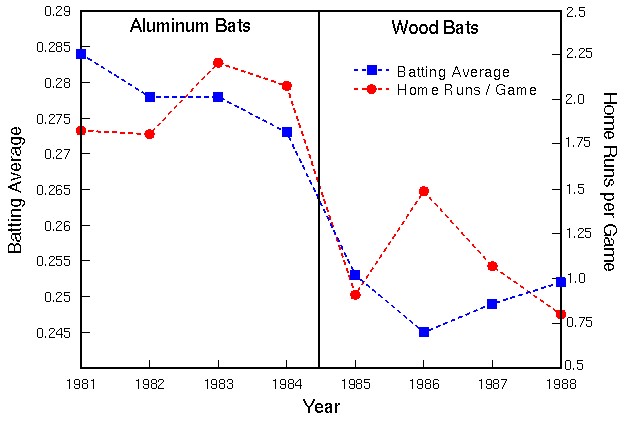
One more set of statistics which illustrate the effect of aluminum bats on the level of play in college baseball comes from the Cape Cod Baseball League, the premier amateur summer baseball league for leading pro prospects. Prior to 1984 players in the CCBL were allowed to use aluminum bats. Starting with the 1985 season the league returned to wood bats only. The graph at right shows batting averages and number of home runs per game from the years 1981-1988. As the data shows, both the mean batting averages and the frequency of home runs per game dropped noticeably after the return to wood.[9] Most baseball players who successfully make the transition from using aluminum bats in college to playing with wood bats in the pros will agree that if you hit the ball just right with a wooden bat it will go about the same distance as a ball hit with aluminum. The trick is learning to hit the ball just right. With an aluminum bat you can hit the ball almost anywhere along the length of the bat and still get the ball past the infield. With a wood bat the task is much more difficult.
An interesting 1994 study of Japanese High School baseball players[10] comparing the wood-only and metal bat eras in Japanese baseball found that after the introduction of metal bats, winning teams had a higher percentage of larger, stronger players. In the wood-only era winning teams won games by getting lots of men on base with well placed singles, moving players by stealing bases and sacrifice bunts, and applying squeeze plays. After metal bats were introduced, winning teams won mostly by relying on the long ball with larger players who had built up muscle mass through weight training and who could take advantage of the hotter metal bats to hit more multiple-base hits and home runs. Both the average player physique and the number of home runs per game increased substantially after the introduction of metal bats into Japanese high school baseball. |
Back to Physics and Acoustics of Baseball & Softball Bats